By the myPitLab team · Last updated 17 April 2026 · 5 min read
TL;DR
- UK survey clients (developers, engineers, water companies, councils) are increasingly asking for portal access rather than PDF deliverables
- The shift mirrors what happened in topographic survey and BIM 5-10 years ago; drainage and utility work is catching up
- Portals reduce follow-up emails, increase repeat work, and position the surveyor as a strategic partner rather than a report vendor
- The cost of not offering a portal is quiet but real: clients choose competitors who do
- A portal is a business decision, not a software upgrade

Key takeaways
- Clients who get portal access raise more follow-up work orders than clients who get ZIP files
- The surveyor's competitive position in 2026 depends on how the data is delivered, not just how it's captured
- Portals shift the client relationship from "one-off transaction" to "ongoing asset access" — with PAS128 reports, geo-photos, CAD and GIS downloads behind the same login.
- UK tier-one contractors and major developers now expect portal delivery as standard
- The smaller firms that adopt portals early win disproportionately against larger incumbents
In this article
- The deliverable your client actually wants
- What changed between 2020 and 2026
- What a good survey client portal looks like
- The business case for portal delivery
- When PDF is still the right answer
- Frequently asked questions
Introduction
A UK developer ordering a drainage survey in 2020 expected a PDF report, a few DWG files and a ZIP of photos, delivered by email or WeTransfer. In 2026, that same developer is more likely to ask where they log in to see the data.
This is a quiet but meaningful shift in UK survey delivery. The clients who drive it are the ones most likely to commission repeat work: large developers, tier-one contractors, water companies, asset owners. The surveyors winning their work in 2026 are the ones who've moved their delivery model to match. myPitLab includes client portal access as standard for UK survey firms, with no per-user cost for the client side.
Here's why the shift is happening and what it means for the firms on either side of it.
The deliverable your client actually wants
Put yourself in the position of a civil engineer at a UK tier-one contractor. You commission drainage surveys for 30 projects a year across the country. Each one produces a report, a set of CAD files and a photo folder.
What happens to that data? Usually:
- The PDF goes into a project folder on SharePoint
- The DWG goes to the design team and gets merged into the main drawing
- The photos sit in the folder unreferenced
- The report structure isn't searchable across projects
- Six months later, when a question comes up, someone spends 40 minutes finding the right PDF
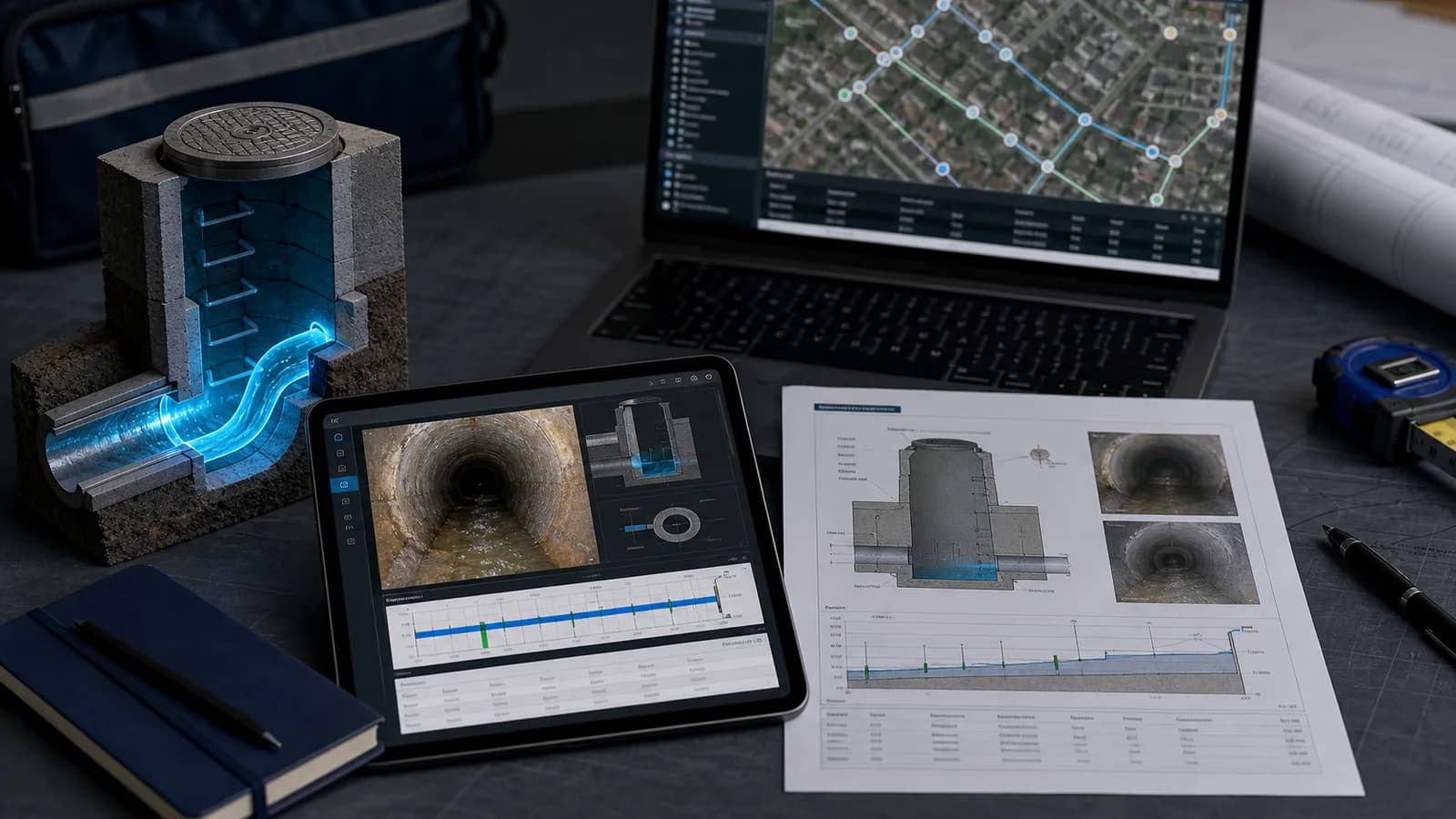
Now imagine the alternative. The surveyor delivers a portal link. You log in, see all 30 projects on a map, click into one, see the assets, rotate a 3D chamber model, download the specific piece of CAD you need, forward a colleague a link to a specific manhole.
Which delivery model makes the surveyor look like a partner versus a vendor?
What changed between 2020 and 2026
Three things shifted.
Client expectations hardened. The same engineers and managers who use SaaS in every other part of their life started expecting it from surveyors too. "Send me the PDF" is still common, but "send me the link" is catching up fast.
The competitive market compressed. More UK survey firms are offering portals, which means clients have a real choice. A firm not offering portal access is visibly behind. The choice used to be paper or digital; now it's PDF or portal.
The platforms got better. Building a client portal as an individual survey firm used to mean custom development. In 2026, it's a feature included in modern survey platforms at no extra build cost.
The combination means portal delivery went from "nice to have" to "normal" in roughly three years.
What a good survey client portal looks like
Not all portals are equal. The ones that actually get used by clients share a few traits.
Zero training required. A link, an email, a password, a map. If the client needs a 30-minute call to understand how to navigate the portal, it's not ready.
Client-specific access. Each client sees only their own projects and assets. Controls on which team members within the client's organisation can view what, with simple invitation flow.
Multi-device, no app. Works in browser on desktop, tablet and phone. No app download, no platform-specific requirement.
Branded to the survey firm. The client sees your logo and your colours, not the software vendor's. The portal is your deliverable, not theirs.
All artifacts in one place. Report PDF, CAD files, photos, 3D models, structured data exports, all accessible from the same asset page.
Searchable and queryable. Find every MH over 3 metres, every chamber with collapsed benching, every cover rated poor. A folder of PDFs can't do this; a portal can.
Secure link sharing. Client can forward a specific asset or a specific report to a colleague via link, without granting full portal access.
💡 Your firm's portal, your client's access myPitLab includes a branded client portal for every project, with 3D models, interactive asset maps, and one-click data export. No per-user pricing for client access. Start free on myPitLab - deliver your next project in a portal →
The business case for portal delivery
Portal delivery pays back in ways that don't always show up on a quote line.
Repeat work increases. Clients who can see their asset data at any time, who can browse past projects you've delivered, tend to come back for follow-up work. The data becomes the relationship.
Margin on the current job improves. Portals reduce the number of "can you send me X again?" emails by roughly 60-80 percent in the months after delivery. That's office time reclaimed.
Sales conversations change. When a prospect asks "what's your deliverable?", showing a portal demo is dramatically more compelling than describing a PDF report. The portal becomes a sales asset, not just a delivery tool.
Client retention gets stickier. Clients invested in a portal (even passively, by having their asset data there) are less likely to move to a competitor, because the competitor starts from zero while you hold their history.
Referrals improve. Clients who've used a good portal mention it to peers. "Their delivery is different" is a referral-worthy observation in a commoditised market.
None of these are revolutionary. Together, they're the quiet difference between survey firms growing at 5 percent and survey firms growing at 25 percent.
When PDF is still the right answer
Portal isn't always the answer. PDFs still make sense for:
- One-off clients who won't return (private domestic clients, small one-day surveys)
- Specific regulatory submissions where PDF is explicitly required
- Legal documents where a signed-and-stamped PDF is the deliverable itself
- Clients with IT environments that restrict external portal access
The right approach is portal by default, PDF on request. Most modern platforms export PDFs from the portal with one click, so you lose nothing by offering both.
Frequently asked questions
Do clients actually use portals or do they still ask for the PDF? Mixed picture. Engineers and project managers use portals heavily. Senior decision-makers who only need a one-time summary often still download the PDF and move on. The best approach is to make both available.
What does a client portal cost to provide? On the right platform, nothing extra per client user. Look carefully at pricing models; per-user pricing for client portal access kills the economics. myPitLab does not charge per client portal user.
How secure is a typical survey client portal? Modern portals use industry-standard authentication, encryption in transit and at rest, and granular access control per project. Security is typically better than sending a ZIP file via WeTransfer.
What happens to the portal after the project ends? Varies by platform. Reputable platforms keep the portal live indefinitely for past projects, so the client can return months or years later and still access the data.
Can clients export their own data from the portal? Yes, on good platforms. Clients should be able to export their project data (CAD, PDF, DXF, KML/KMZ, CSV, JSON) from the portal without needing to contact the surveyor.
Is the portal branded to my firm or to the software vendor? Depends on the platform. The best ones brand to your firm with your logo, your colours and your domain. Look for white-label client portal support before committing.
The portal is the deliverable
Survey firms in 2026 are judged not only by the quality of the data they capture, but by how the client gets access to it. The ones who've moved to portal-first delivery are building repeat work and client loyalty that PDF-delivery firms can't match.
myPitLab includes a branded client portal as standard for every UK survey firm, with free trial access.
Start free on myPitLab - give your next client a portal →
Sources:
- TSA (The Survey Association) digital delivery guidance
- ICES industry surveys on deliverable trends
- UK BIM Framework client data sharing principles
Disclaimer: This article is general guidance for UK survey firms. Specific client requirements vary by sector and contract; always verify deliverable expectations with each client.
Internal link suggestions:
- /blog/manhole-inspection-software-3d-uk-guide (Pillar 1)
- /blog/survey-monitoring-software-uk (Pillar 2)
- /blog/all-in-one-survey-platform-uk-2026 (Pillar 3)
Image suggestions:
- Hero: Split view of old ZIP+email delivery vs modern portal on laptop and phone (alt: "Survey deliverable comparison: ZIP file versus client portal")
- Mid-article: myPitLab client portal with 3D chamber and map view (alt: "myPitLab branded client portal showing drainage assets")