By the myPitLab team · Last updated 28 July 2026 · 8 min read
TL;DR
- A good manhole report is generated from validated structured data, not assembled manually from text boxes.
- Every report needs clear asset identity, location, levels, chamber geometry, pipe information, condition and photo evidence.
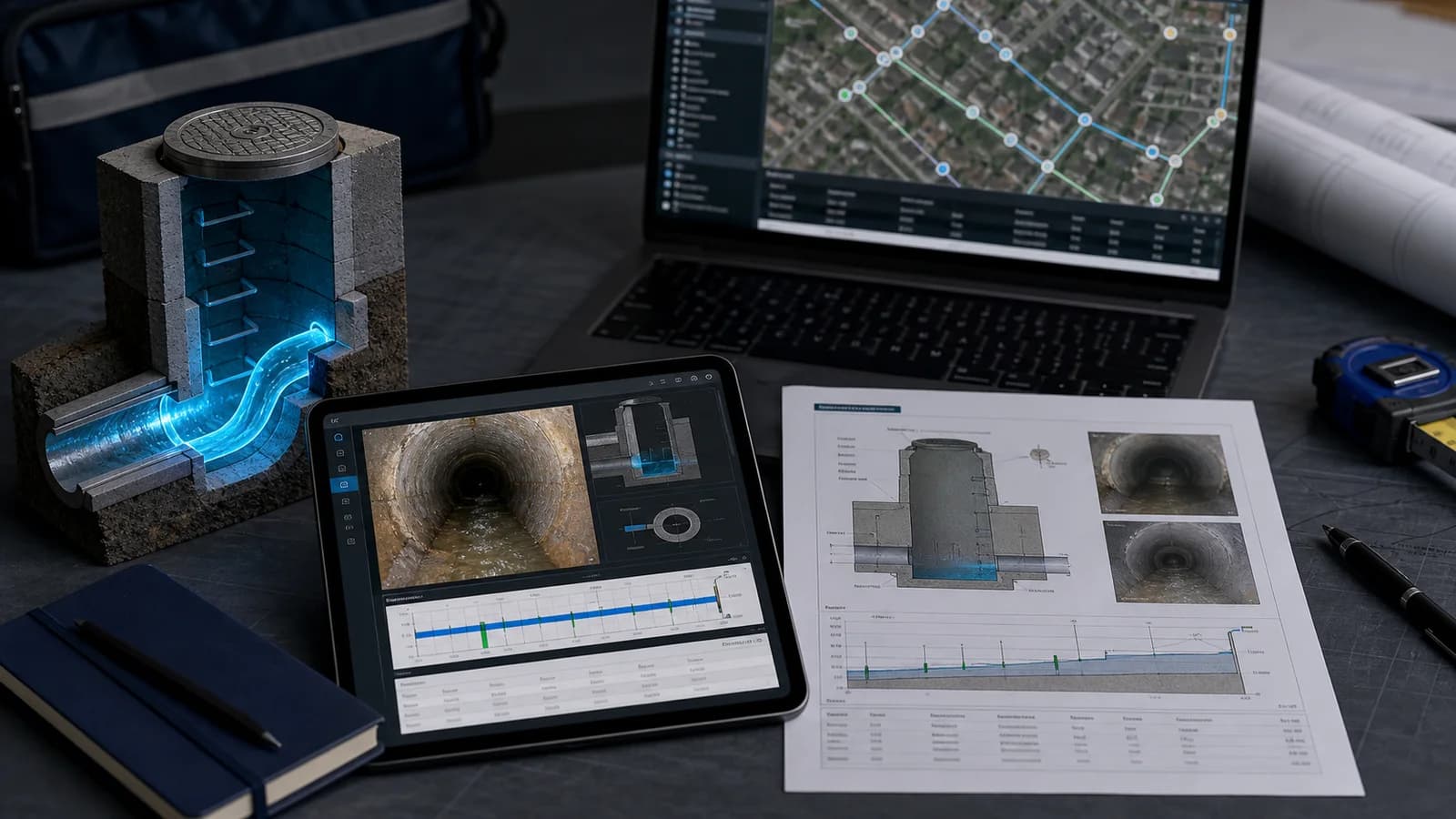
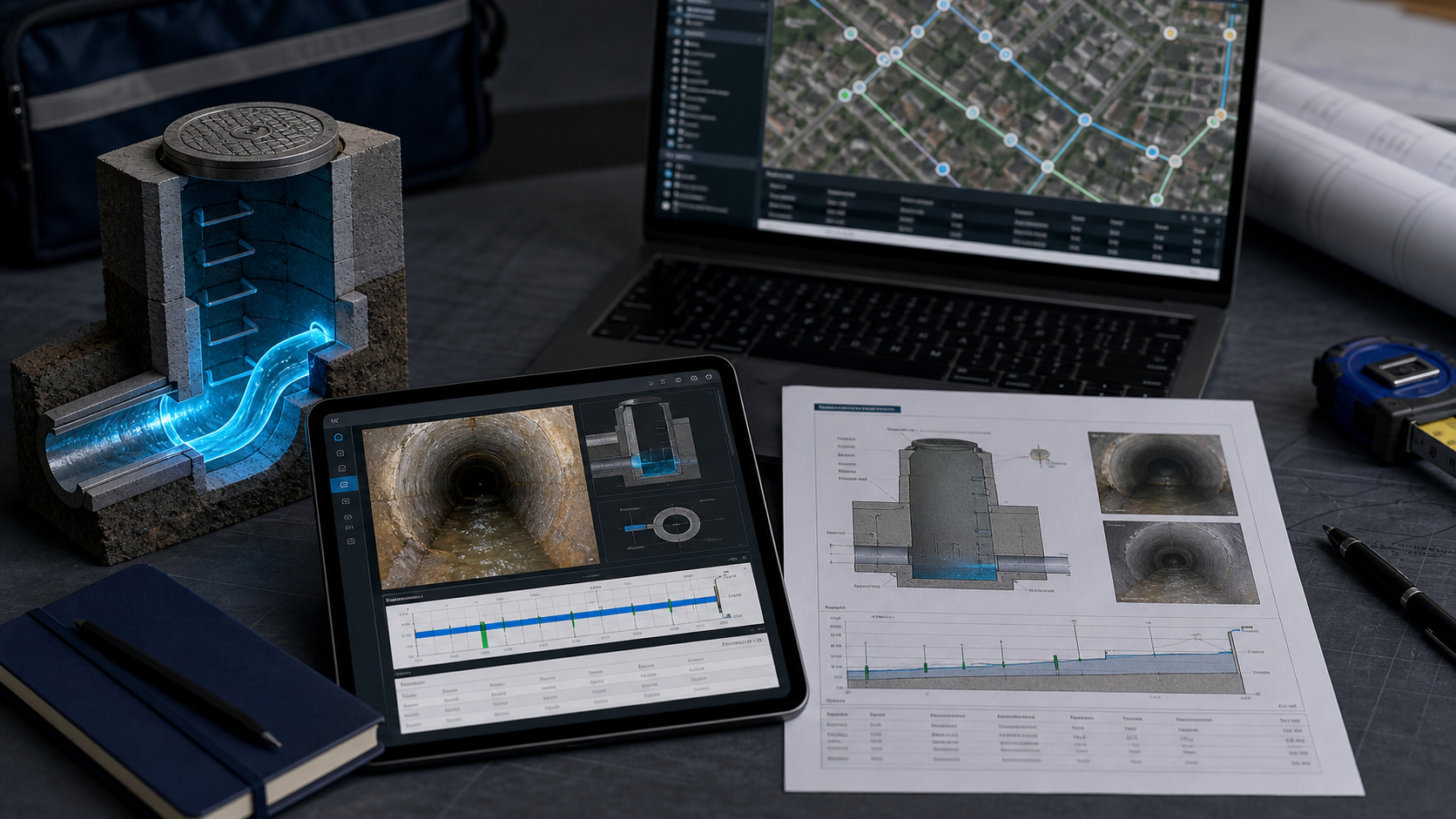
- The cross-section must use the same cover, shaft, chamber, water, silt and pipe data as the 3D model.
- PDF layout should be tested at A4 size so labels, photos and diagrams never overlap or clip.
- The report is one part of the handover; clients increasingly expect GIS, CAD, imagery and a secure portal too.
Why static templates fail
Many firms begin with a Word or Excel template. It works until:
- A chamber has more pipes than the table supports
- Long defect notes overflow
- Photographs have different aspect ratios
- A logo or client footer changes
- A cross-section label overlaps another pipe
- The PDF renderer uses different fonts from the preview
The answer is not a larger blank box. A reliable report template needs layout rules that respond to the inspection data.
Essential report sections
1. Document control
Include project, client, report reference, revision, status, author, checker, approver and publication date. The downloaded PDF should make it obvious whether it is draft or published.
2. Asset identity
Show:
- MH or IC code
- Project and site
- Inspection date
- Asset type and system
- Coordinate reference system
- Easting, northing and elevation where available
Asset IDs must match the project map, filenames, KML/KMZ export and DXF layers.
3. Cover and chamber details
Record cover shape, dimensions, duty or class, frame condition, access arrangement, shaft material, chamber material, chamber dimensions and depth.
Where cover level is known, show it with the datum. Do not present an unreferenced number as mAOD.
4. Pipe schedule
Each pipe row should include:
- Unique pipe reference
- Incoming or outgoing
- Clock position or bearing
- Diameter
- Material
- Depth and depth reference
- Invert level where calculated
- Condition and notes
Editing one pipe must update that pipe—not create a duplicate. Stable pipe identifiers are important for offline sync and revision history.
5. Water and silt
Show water and silt readings with an explicit reference such as metres above chamber floor. The values should update the cross-section and 3D cutaway consistently.
6. Condition, defects and recommendations
Separate factual observations from recommendations. Link defects to evidence photographs and, where possible, to their position in the model.
Cross-section requirements
A useful cross-section should reflect:
- Cover shape and thickness
- Frame and seating
- Shaft geometry
- Chamber width and depth
- Benching and channel
- Water and silt levels
- Pipe diameter, direction and depth
- Ground and cover levels
The diagram should be derived from the same data as the 3D view. Maintaining a separate hand-drawn section creates a second source of truth.
For crowded chambers, apply collision-aware labels, group repeated information and provide a detailed pipe table below the diagram. Never shrink text until it becomes unreadable.
Photo page design
Use consistent image containers and preserve aspect ratio. A robust template can accommodate:
- Cover and location photograph
- Chamber overview
- Individual pipe photographs
- Wall defects
- Before and after imagery
- Annotated evidence
Every image should have a caption, asset ID and optional direction. See the geo-photo survey guide.
Executive summary for project reports
A project-level pack should add:
- Number of MH and IC assets
- Published, incomplete and rejected counts
- Condition distribution
- Critical defects
- Missing coordinates, levels or photographs
- Water and silt exceptions
- Project map with status legend
This gives the client a management view before the detailed inspection sheets.
Three useful visual styles
Executive Clean spacing, concise findings and strong summary pages for decision-makers.
Technical Blueprint Higher information density, technical linework, dimensions and CAD-oriented presentation.
Photo Editorial Large evidence imagery, defect stories and visual before/after comparison.
Branding can change colours, logo, footer and terminology, but it should not remove mandatory QA information.
A4 PDF validation checklist
Before releasing a template:
- Render every page at actual A4 dimensions
- Test minimum and maximum pipe counts
- Test long asset codes and client names
- Test portrait and landscape photographs
- Verify page breaks
- Embed or safely substitute fonts
- Confirm headers and footers do not overlap content
- Confirm links and QR codes remain readable
- Compare browser preview with downloaded PDF
Automated visual regression images are valuable because a technically successful PDF generation can still produce a poor page.
Beyond one PDF
A modern handover may combine:
- Inspection PDF
- Original photographs
- DXF
- KML/KMZ
- CSV
- Interactive 3D model
- Short model animation
- Client portal link
The report remains important, but it should link back to the same verified asset record rather than becoming an isolated final file.
Frequently asked questions
Can I use one template for MH and IC? You can share branding and document-control components, but chamber fields and diagram rules should respond to the asset type.
Should the PDF contain a QR code? A QR code can link directly to the published asset model in the client portal. Ensure access controls and link expiry match the project.
What should happen when cover level is missing? Flag it clearly. Do not calculate or display a misleading invert level without the required reference. Full capture rules: manhole cover and invert levels.
How many photographs should be included? Use the project specification and enough evidence to support every important observation. Quality and traceability matter more than an arbitrary count.
Summary
The strongest manhole inspection report templates are responsive views of validated data. They keep pipe schedules, cross-sections, photographs, levels, QA and client branding consistent—and they fit cleanly on A4 in both preview and download.